Personal project
AI Text Detector Lite
A small, inspectable heuristic for spotting AI-written text — and a walkthrough of the two-level detection pipeline it comes from. No account, no server: every number below is computed in your browser from what you paste.
1 · Four-signal heuristic
Sentence-length variation, formulaic phrases, repetition and vocabulary uniformity, weighted into one score. 80–5,000 characters — the same text feeds the lab in step 2.
A probabilistic signal, not proof of authorship. Polished human writing and varied AI writing both defeat heuristics like this one; short, translated or heavily edited text is especially easy to misjudge.
Upload files, sentence-level highlighting and the production model. This Lite page runs four transparent signals in your browser.
Continue on lynote.ai ↗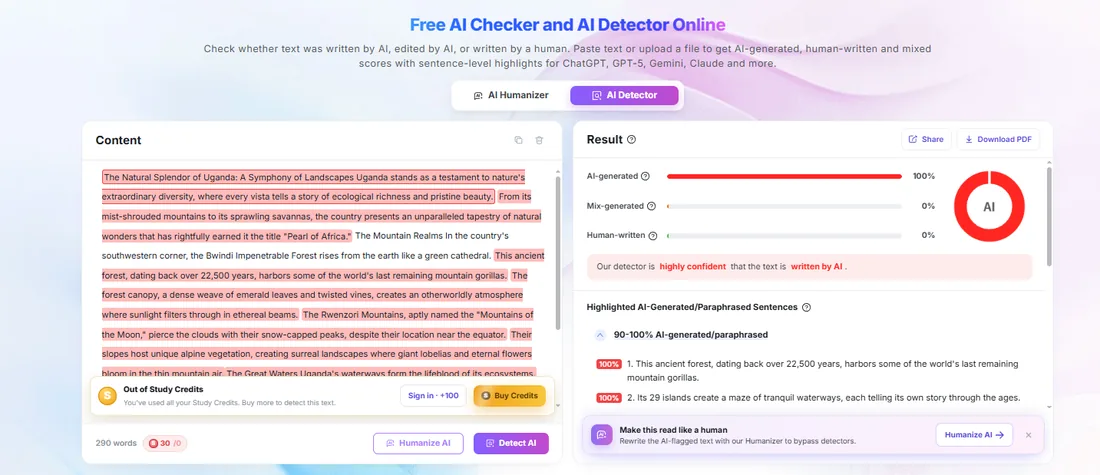
2 · Two-level detection lab
Runs on the text you pasted in step 1 — one input, two views. The sentence splitter is real; the probabilities are the published demo vector. No backbone is loaded here.
1. Sentences and paragraphs
2. Two-level batch
3. Temperature scaling and confidence bands
4. Result JSON
5. Response-contract fields
app.js directly to check it is being served.
What is an AI detector?
An AI detector estimates whether a piece of text was written by a language model rather than
a person. Commercial detectors usually run a trained classifier and return a percentage.
This page does something deliberately smaller and more honest: it runs four statistics over
your text, weights them, and shows you both the total and each part. The weights are in
app.js; nothing is hidden behind an API.
Use cases
A heuristic like this is a reading aid, not a verdict machine. These are the jobs it does well.
Check your own draft before you submit
Run a paragraph through the heuristic before you send it. The four signal values tell you which property triggered the score, so you can fix the actual cause — uniform sentence length, repeated phrases — instead of rewriting blindly.
Find machine-written paragraphs while editing
On a long document, the per-signal numbers show whether the whole text is uniform or only one section is. That is more useful than a single percentage when you are deciding what to edit.
See how detection heuristics actually work
The pipeline lab splits your text into sentences and paragraphs, shows the 128-token and 512-token budgets, and renders the response contract a production detector returns. It is a teaching tool, not a black box.
Compare drafts or writing styles
Feed the same brief written two ways and compare the scores. The bands make it easy to see which version is more variable in rhythm and vocabulary.
Not for accusations
A score is not evidence. Do not use this page alone to accuse a student, an applicant or a colleague — see the limits below.
How to read the score
The score runs from 0 to 100%. Below 35% is a weak AI-generated signal, 35–65% is mixed, and above 65% is a strong signal. The band matters more than the exact number: a text at 44% and a text at 46% are in the same bucket, and the difference between them is noise. Look at the four signal bars instead — they tell you why the score landed where it did.
The four signals
| Signal | Weight | What it measures |
|---|---|---|
| Sentence-length variation | 0.35 | Uniform rhythm scores high; bursty, uneven rhythm scores low. |
| Formulaic phrases | 0.25 | Known clichés per 100 tokens, English and Chinese. |
| Repetition | 0.20 | Repeated 3-grams plus repeated sentence starters. |
| Vocabulary uniformity | 0.20 | Type–token ratio: low diversity scores high. |
Lite vs Pro
| Lite (this page) | Pro on lynote.ai | |
|---|---|---|
| Price | Free | Paid plan |
| Engine | Four-signal heuristic, visible in the page source | Production detector model |
| Input | 80–5,000 characters pasted | Paste or upload |
| Output | Weighted score plus per-signal bars | Sentence-level highlights, PDF report |
| Privacy | Runs in your browser | Server-side processing |
Frequently asked questions
What is an AI detector?
An AI detector estimates whether a piece of text was written by a language model rather than a person. Most commercial detectors run a trained classifier. This page runs a transparent heuristic instead: four statistics, published weights, computed in your browser.
Is this AI detector free?
Yes. The free basic build needs no account and no upload. It scores 80 to 5,000 characters per run, and the pipeline lab works on the same input.
How accurate is it?
There is no single number worth quoting. Accuracy depends on the text, on which model produced it and on how much it was edited afterwards, so a fixed figure across all of those would be meaningless. What this page gives you instead is the method: you can read the weights in app.js and judge the output rather than trust a badge.
Why does it need at least 80 characters?
Sentence-length variation and repetition need several sentences before the statistics mean anything. Below 80 characters the score moves around far more than the text does, so the page refuses to guess rather than giving you a confident-looking number.
Does it work on Chinese text?
Yes. Word counting treats each Han character as a token, the formulaic-phrase list includes Chinese clichés, and sentence splitting handles 。, !, ? and … in addition to English punctuation.
Is my text stored or uploaded?
No. Scoring runs in your browser. The only files fetched from the server are the demo JSON files the pipeline lab needs, which contain no user text.
Can it tell ChatGPT from Claude or Gemini?
No, and neither can most detectors. It measures properties of the writing — rhythm, repetition, vocabulary spread — not a model fingerprint, so it cannot attribute text to a particular assistant.
What is the difference between Lite and Pro?
Lite is this page: a four-signal heuristic plus the pipeline lab, running locally and free. Pro, on lynote.ai, adds file upload, sentence-level highlighting and the production model behind a paid plan.
What this is not
- Not a verdict. It cannot establish authorship, and it should never be the only input to a disciplinary, legal or moderation decision.
- Not the production model. The lab's probability fields are the published demo vector, softened by the temperature slider.
- Not trained on your text. There is no training loop here and no request leaves the page.
Related
If the problem is that a draft sounds machine-written, the AI Text Humanizer on this site removes the usual clichés in the browser.
Pro adds upload, sentence-level highlighting and the production model.
Continue on lynote.ai ↗